 The
city of Kathmandu
Langtang and Helambu 12 day trek, Nepal
Click on the photographs to enlarge
In
May 2000 my wife and I undertook a trek in the Langtang and Helambu valleys,
Nepal. We are both well 50+ and not particularly athletic, and wondered
afterwards what had possessed us! However it was a unique experience, and
perhaps sharing this with other elderly trekkers may be of use, or at least
cause some amusement. We did a lot
of reading before going – all the trekking guides to the area, but some need
updating! Women do not trek in skirts!!
The
city of Kathmandu
We
were personally recommended to the Last Frontier Trekking company (details
below), by an American friend, and had previously arranged the trek via email
from England. Mingma Sherpa was
excellent in responding rapidly to our questions, and we made some final
adjustments to the programme when we arrived in Kathmandu, went to his office,
and met our guide. Their rates turned out to be reasonable.
We cannot fault the organisation, and our guide and porter were
incredibly kind and attentive to our every need. K, an experienced guide,
watched us carefully over the really rough bits of the trail, and gave us gentle
encouragement, when we had already had enough (especially in the first few days
days!). He checked our
accommodation, ordered us drinks, waited on us at mealtime, got extra mattresses
etc, and both he and Tanka, the
porter, were always smiling and cheerful. We wouldn’t have got through the
first day, or to the end of the trail without them, whatever the guide books may
say. It was also really important
to have a charming Nepali companion who could interpret, and was of course very
knowledgeable about every aspect of the area we were trekking through. We
didn’t have to think about any organisational aspects, which was a great
relief. We just paid for the beers,
everything else was included.
Friday 24th May.
The road to Syabru Bensi
At 7am we left the civilization of d' l Annapurna Hotel, Kathmandu, for a jeep with driver, K and Tanka. The 'highroad' north to Dunche out of Kathmandu is a single lane ‘road’, with variable amounts of tarmac, max speed possible 30 Km / hr. After Trisuli (trident - 3 rivers meet) it becomes a farm track suitable for tractors. There is 85Km of this. We straight away go into a ditch and slightly damage the front suspension and steering rods.
 Jeep
not up to it
This doesn’t seem to worry anyone unduly, although the play in the steering wheel increases noticeably. The wishbone suspension, now very tired, transmits each rock and bolder over which we drive for the next 8 hours. The farm track has 1000 m drop on one side, and a happy 2 hours are spent while 6 lorries try to make it round a steep and narrow bend made slippery by early monsoon rain.
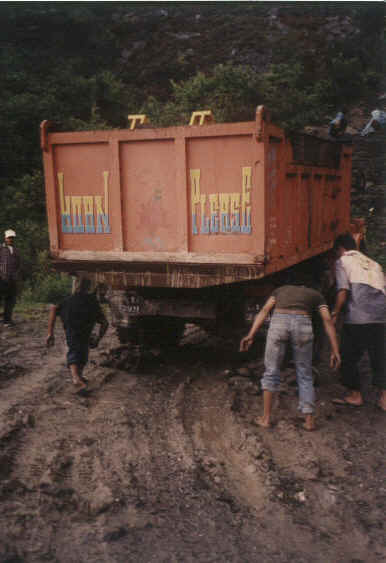
We all carry stones and throw them under the wheels, it rains heavily. However a high level of good humour prevails and we reach Syabru Bensi at 5.30pm. Excellent lodge with own room,. even a shower room and electricity. We had to save a day, so we missed out the Dunche to Syabru trek.
 Road to Syabru Bensi
First
encounter with a leach, it got into my hiking boot and fed well. Excellent food
- potato & cheese momo (fried in pastry) a local speciality. Slept well with
the soothing sound of the river in flood through our open window.
From tomorrow there is no road for vehicles and we start to trek proper.
27th
May Day 1.
A
huge hike up to Langtang Hotel.
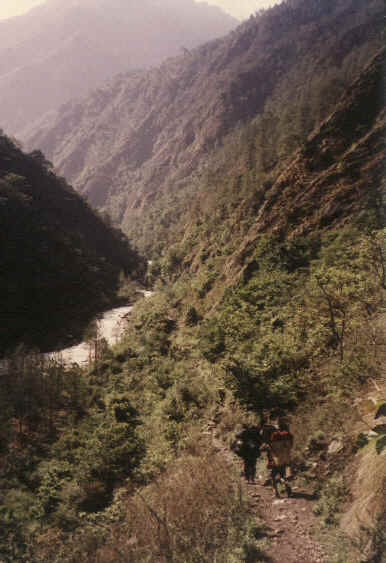
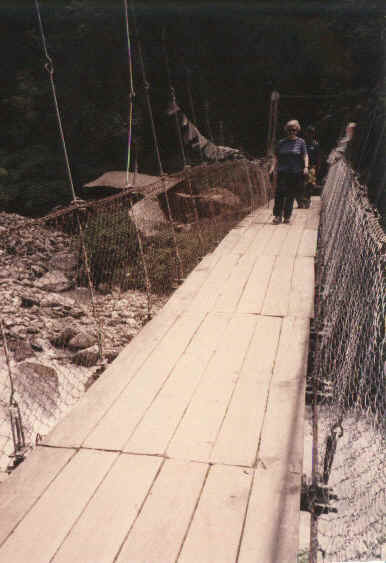
Lunch at Sherpa Bamboo. Very hot and very beautiful, by the river, or 400 metres above it. I stopped regularly to fill my hat with water from the many streams – very cooling. The trail was edged by wild gunga plants and many small waterfalls.
The Langtang river flows briskly and noisily all the time. The higher you climb the more the noise of the cicadas takes over. Nearer to Rimche it was similar to climbing a steep uneven staircase about 5 Km long.
 the last straw! but
 rimche
at last!
We got extremely tired, being very unfit and walking much too fast, as we were to discover later. There was the time when we nearly didn’t make it! Lama Hotel was reached by 3.30pm.

We met Dan and Sam from Sydney and Wimbledon, lovely,
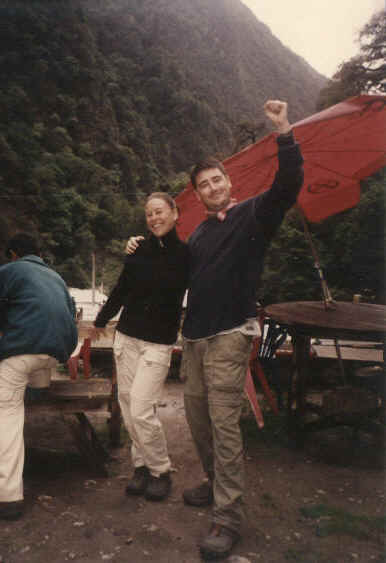 sam and dan
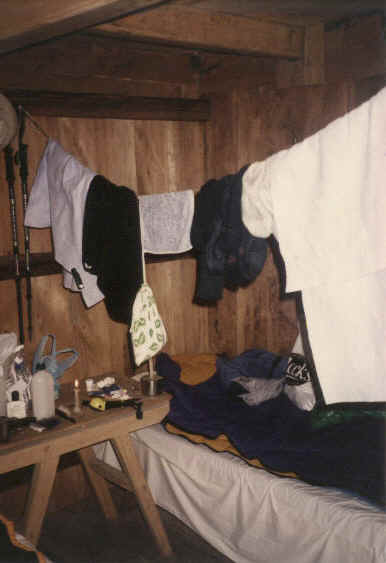 our room at lamahotel
and a large Dutch group noisey and chain-smoking, less lovely. Going to the toilet (charpi)
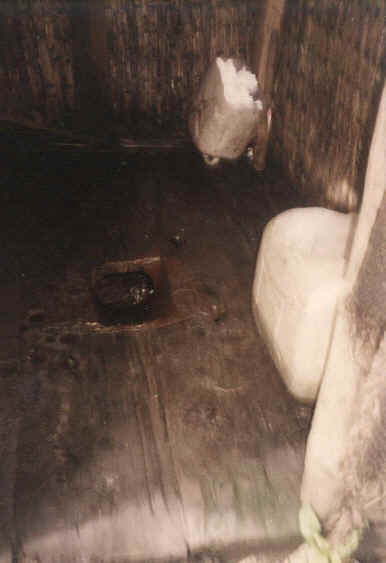
during the night involved negotiating a
herd of cows / yaks. FOOD: There is one standard menu throughout the national
park so no suprises!. Dal Bhaat is eaten by everyone including us. Garlic soup
is recommended for altitude - very good. We
are at 2400 metres, so we climbed more than 1000 metres in 7 hours on our first
day, not to be recommended - mostly straight up! Stop at Rimche instead.
28th
May Day 2
7 am start and compared to yesterday, this is a gentle saunter through rain forest by the Langtang river, and very beautiful.
We are lucky with another day of fine weather, and by lunch time at Ghora Tabela, the valley has opened out into pastures with cows and quite a few buildings.
Getting cloudy, and cooler, we still can’t see the mountains. Much better progress today, we reached Langtang and found a nice quiet lodge with only 6 bedrooms (Langtang village guest house).
A really hot solar shower
was a nice suprise. They lit a fire! Met two nice nice Irish lads, Damian &
Eddie who said they were going nowhere slowly. Our paths crossed agreeably on
many of the following days of our journey.
29th
May Day 3.
A half day trek to Kyanjin Gompa. This was much easier and we got there by lunch time. Stayed at ‘Mountain View Hotel’ and missed the chain smokers!
 with
porter Tanka and guide K in the dining room
Masses of porters arrive with stuff for a great camping expedition we are just going to miss. The snow-topped peaks of Langtang Lirung are clearly visible (7225m), and the following morning at 5am a short trek brings Himal Langtang into view with the source of the Langtang river.
We fail to climb a nearby unnamed peak, as the
weather closes in. We get to about 4500 metres. Until now we have been very
lucky, hot sun in the morning and only rain in the evening and at night, after
we arrive at our lodge. It is very cold at night up here and apart from wearing
everything you own inside the
sleeping bag, the great luxury is having your water bottles filled with boiling
water for the next day. Wrapped in a tolerably clean gortex sock they make the
ultimate hot water bottle. We pass on the solar shower today, as there is a
large open window facing onto the main road..
30th
May Day 4.
We’ve been right up the Langtang valley and we are already turning back, thinking how nice it will be to go downhill for a change.
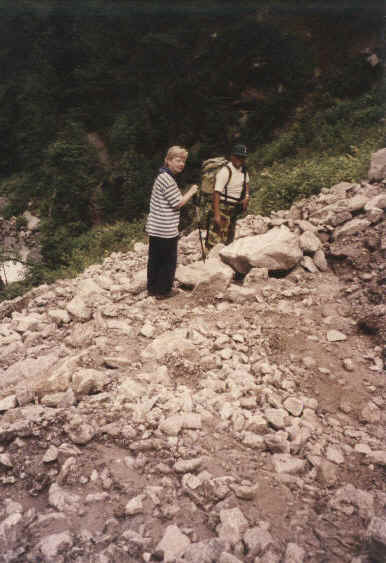 a
small landslide
But it takes 8 hours to get back to
Lama hotel and going down hill uses a whole lot of different muscles! I found
having 2 poles and using them like a Zimmer frame is quite effective!
Good practice for retirement in 2 years time.
This time we are in fine rain. The
monsoon is beginning, and the rain forest certainly lives up to its name . We
stay again at Lama hotel rather than follow plan 1 (to head on for Rimche). We
are the sole occupants of the whole village. 2 beers, fried eggs and chips - a
slight change in diet makes us feel like real English. We try raksi the local
fire water, which is excellent when mixed with lemon juice. A glass of neat
raksi (more than 2 can drink) costs
40c.
31st
May Day 5.
Down the bit that nearly finished us on the first day; it looks so easy on the way down. Pleasant stops to chat with trekkers from Oregon etc..Then...REAL rain. We stop for lunch at Bambo. The Irish pair reappear, having done in 1 morning what took us nearly 2 days; sickening. This valley is really wonderful, bird song, ever changing trees and plants and mostly a 1000 metre drop to the valley floor.
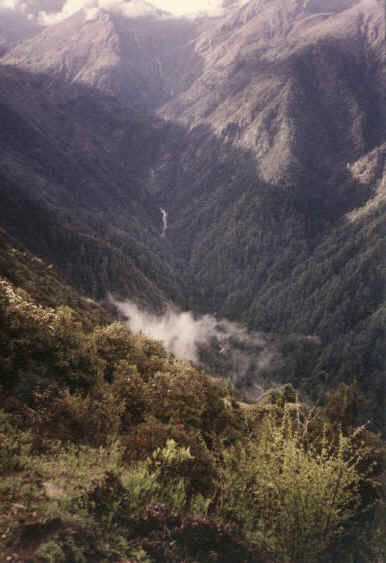
The climb up from bamboo seems less of a hike, perhaps we are getting the hang of it. We reach Thulo Syabru (thulo = peak) 2265m,
 Thulo
Syabru and views from the Yak hotel
just above where we started at Syabru Bensi (bensi = low) and search amoung the guest houses all eager for trekkers in the low season. We pick Hotel Yak! There is a fabulous view over terraces of barley and corn and the other way, up the Langtang valley, and snow covered peaks at the top as the sun sets. We can see the Himal Tibet from here too.
Solar heat not so good today. but we shower and wash some clothes (not worth the effort). The kindly landlady lights a stove under one of the dining room tables. 2 beers later we feel it was really worth the climb of 1000 metrs plus, the view has to be the best ever. The main excitement on arrival was that Rena has had 2 leach holes, one on each ankle, but we could only find one leach!
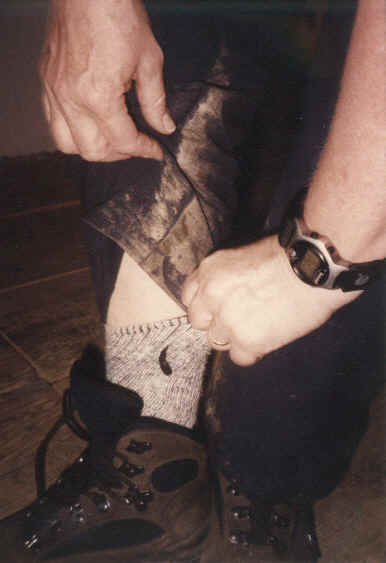
Anti
leach ointment tomorrow, as you need endless plasters to stop the bleeding!
1st June Day 6
Left in bright sunshine after usual breakfast of durdchai (sweet milk tea) and
Tibetan bread with honey. The local Lama opened the Gompa at Syabru and we saw a
6000 year old effigy of the 2nd dali lama repainted by his grat grandfather 100
year ago.
4 hours of climbing straight up to Danda at 3200m.
Met a French couple (medical students) and the Irish who passed us at speed. We were accompanied in the climb by a small child and his grandfather (strong smelling) tending goats (odourless).
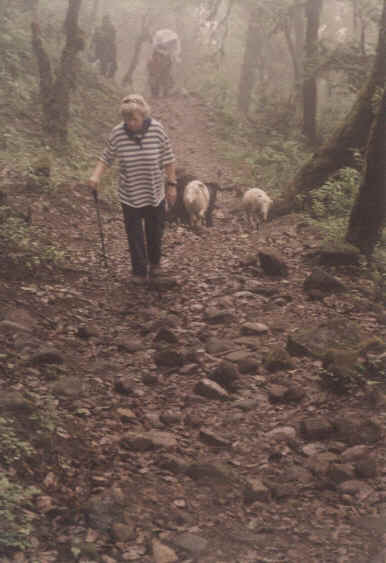
I can only guess what we smell like to them! Lunch in Danda in nice warm sun. After lunch there is a more leisurely traverse to Sing Gompa (1.5 hrs) through an ancient pine forest.
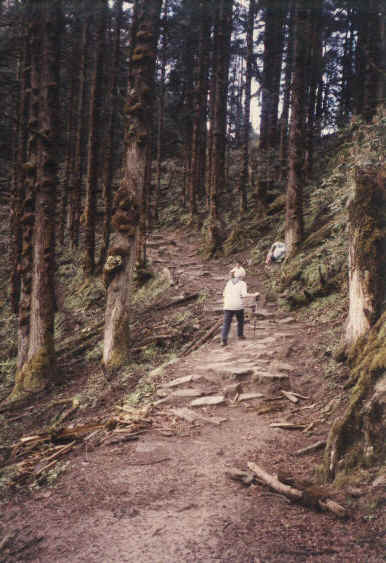
Fabulous view mostly obscured by cloud, but no rain. Arrived at Sing Gompa about 2.30 (3325m) Best choice of rooms, the French couple are already ensconced. We slept a few hours, had tea, visited the cheese factory (and bought some, $3 a kilo).
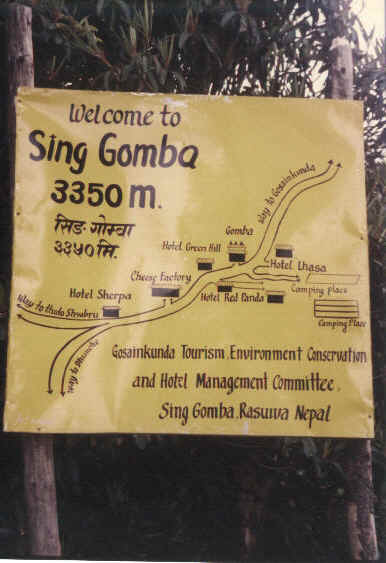
Nice evening spent with the French couple from
Nice, beers, macaroni, and raksi. Very cold at night, so glad of boiled water in
bottles. No showers but large bucket of very hot water (shower bucket-me). Up at
4.45 tomorrow for mega uphill hike to Gosainkund which will be the highest point
(geographically speaking). Rena still smiling and laughing (occasionally).
2nd
June Day 7.
Sing Gompa. Very noisey at 4am so we leave at 6.15am and have nice sunny walk through pine forests with views of Langtang Lirung and Tibetian Hymalayas.
We get to Laurebina (3925m) in under 3 hours (700 m climb), and reach Gosaikund, the sacred lake by 12.00 in just under 6 hours (4385m). On the way there is (for me) some Indiana Jones style cliff hanging ledges
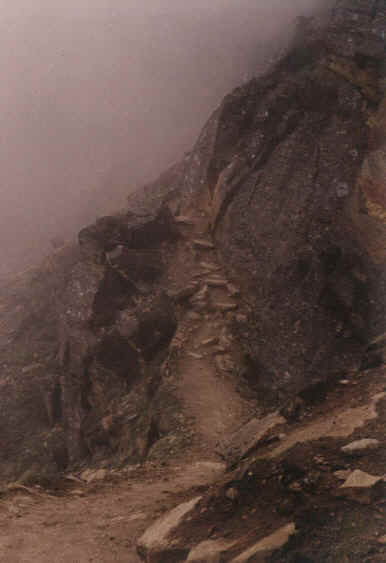
about 4 feet wide with vertical drop to valley floor not much enjoyed as I usually feel vertigo up a ladder. K our lovely guide walked on the outside! He had done it before. In fact he had done everything including carrying clients down on his back after acute mountain sickness. We met quite a few pilgrims at the start, some 75 +, and worried if they would finish!
 Gaisikund lake and Peaceful Lake Lodge
with family yaks
It was initially very quiet and peaceful at the lake, we walk round it in light rain admiring the small rock in the middle which is ‘Shiva’s hat’. A nice fire in the communal living room where we gravitate after a short nap with hot water bottle and all the clothes we have. The view appears very briefly, but if you blink there is cloud cover. Peaceful lake lodge is run by a nice Tibetan lady who walked with us all the way up the mountain knitting the while (shades of ‘looking glass’).
 hat in the making and K, our guide,
modeling the hat
We really had to buy the resultant hat. We also watched
her weaving wonderful colours on a hand loom. This is our highest and coldest
night so far, tomorrow the Laurebina pass, and down the Helambu valley.
3rd
June Day 8.
Gosainkund was wonderful when we first arrived but immediately after dinner all the Hindu pilgrims arrived and it was one continuous noise until 4am when we gave up, and got up, very tired. K did his best to shut them up, but to no avail. The most (apparently) religious people we met, definitely transpired to be without any thought for others!
We reach the Laurebina pass (4660m) in 4 hours,
and started our decent to the Helambu valley. We feel a sense of achievement at reaching this, the highest point, and our guide K seems relieved too! We stopped at Phedi which was deserted, and met Marlena and Marty from Colorado. We ate the yak cheese we bought in Sing Gompa, excellent – like Gouda. Eventually the owner turned up and we got our dal bhaat. Very nearby the horrific Thai air crash of 1992 took place.
There are still s bits of the plane around. Now follows the worst experience of the trip, a DREADFUL hike to Ghopte
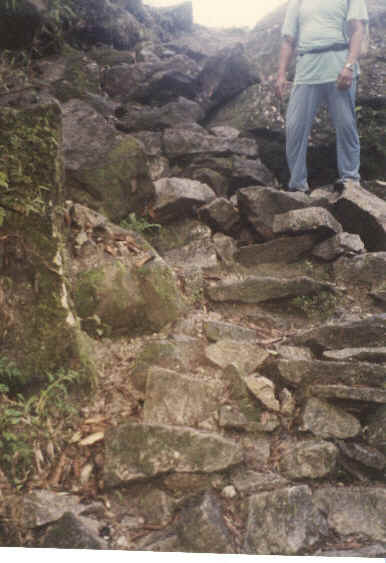
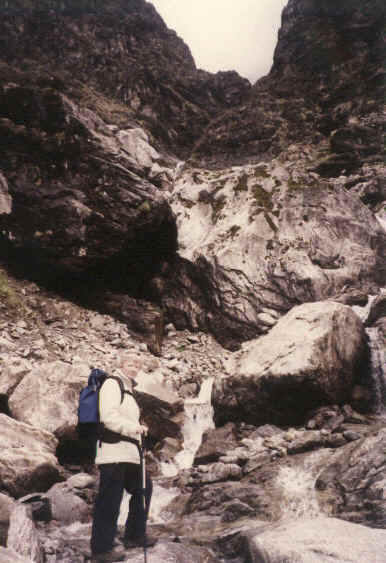
which took another 4-5 hours in the worst rain yet and at breathtaking altitude (for us). We were knackered.
 K at Ghopte, happy we made it!
 Marlena and Marti with water cleaning
kit
We stayed in one of 2 lodges - Tashi Deli.
the only dwellings in this tiny place. The Americans
Marlena and Marti, we met on the way down from the pass, cheered us up,
as did excellent cheese omelettes. Marlena hadn’t like the hike either!
Dormitory accomodation with open cubicles, but only the 6 of us so no
problems. It was pretty cold though. Quite a lot of bird life and lots of Pikas
running around in the evening. Stunning views of Helambu hills when the clouds
cleared in the morning.

4th
June 9th day.
Up at 5am and Rena finds some leech holes, but no leech. We are off in brilliant sunshine towards the Therapati pass, just a little above us and well visible as we walked. In under 3 hours we arrived to find just one lodge open.
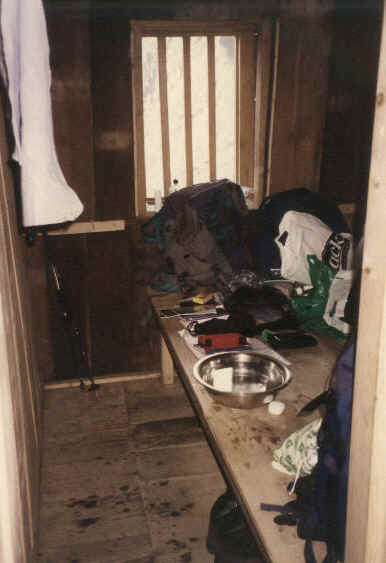
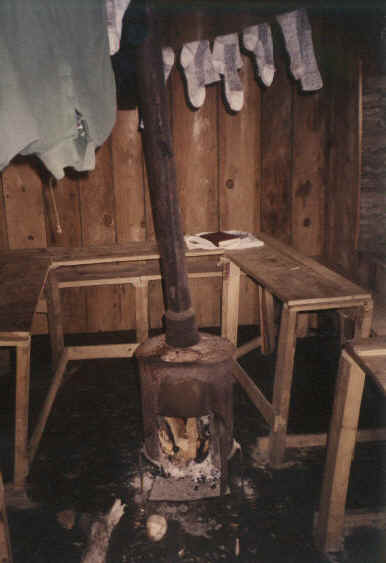
Initial
plans to carry on to Magingoth are abandoned as it is reported closed. Here
there are doors on the rooms. It is suddenly very hot as we sit in the sun
drinking beer at midday. We feel a bit strange having half a day off. We wash socks, and parts
of ourselves, although the local water source here is just a ditch by the side
of the path where rainwater accumulates. The Irish pair turn up around 2.30pm,
so we have good company for the evening. Tanka our porter has a very sore throat
and bad cough. Not much to see but I give him a short course of
antibiotics, and I tell him he will be better in 2 days!
Happily he was. There are violent thunder storms in the night,
fortunately most of the early monsoon rain seems to be falling late afternoon,
or at night.
5th
June Day 10.
Early start 6.30am, as we leave Therapati (3597m) in bright sunshine, which is with us all day. Gets warmer as we descend, through Magengot (checkpoint) 3285m.
There is a pleasant trail through forests and meadows full of alpine flowers. Many wild orchids growing on tree trunks and mosey rocks. We reach Kutumsang in 5hr 40 mins, predicted 6hrs, and have lunch there. I manage to phone daughter Bryony in England on a stuttering solar phone to tell her we are OK.
This is the first phone we have seen since we left Kathmandu. We don’t fancy the Kutumsang lodges, and as we still have plenty of time, we press on to Gul Bhanjyang, or rather a little lodge just before it (Kutumsang Guest house, even though it isn’t).

A simple mud hut, but nice surroundings with a stream
and terraced fields in all directions. Our knees are beginning to detect the
constant downhill, for the first time.
6th
June Day 11
6.30 am start after the usual breakfast. Other beds were occupied during the night by the TV installation man etc. Rocky the Tibetan terrier greets us on our way to the perilous charpi. This was our last night staying anywhere on earth with an outside lavatory. We start off for Chisopani in fine rain. Up and down but mostly down, some of it very steep. We were passed, off and on, by the Irish pair. Damien has knee problem and is looking for the uphill bit! We have daal bhaat at Pati Bhanjyank after walking endlessly though Chipling and other very poor villages with very poor muddy tracks and loads of garbage.
 Main street of village
 What
to do if the midwife arrives
 What
to do if the midwife doesn't arrive
Not as pretty as the north. As we get lower it gets hotter and we are glad of the light rain. After lunch there is a big hike up hill to arrive at Chisopani after 6.5 hours total walking.
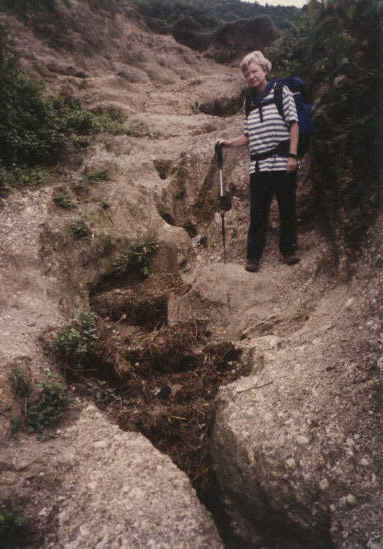
The trail is not clear or marked at all in places.
 if
you can find this track on your own you're amazing!
 cockerel
inspecting the troops
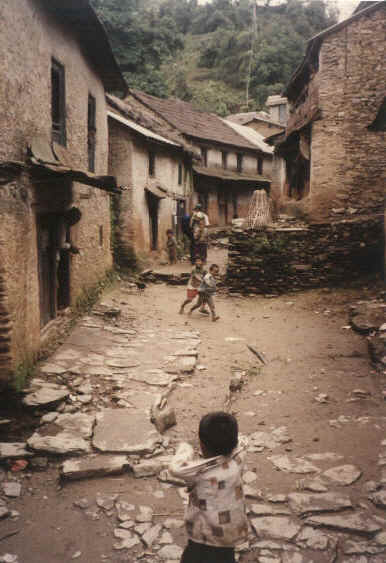 village
where camera finally gave out
The Irish, following us
at this point, got lost and were redirected, but mostly were helped by following
the distinctive footprints left by our guide! Chisopani looks like something the
wild west forgot, but the Sherpa hotel has an inside loo! It also has much
wildlife in the bedrooms, some are pretty insensitive to our fly-spray. We are
the only guests. It has light bulbs, but no electricity since the diesel
generator for the village broke down 8 months ago. Candles in empty beer bottles
again. It is quite nice to have a bedroom with proper walls. We are definitely
looking forward to Hotel de
l'annapurna in KTM tomorrow, with western comforts. We are just too old to slum
it.
7th June Day 12 (last!).
Early
start again from Chisopani and spirits are high as we head (mostly) downwards on
wider tracks (mostly). However lots of mud has been made very slipperly by rain
(in which we walk) and we only occasionally glimpse the view which finally
includes Kathmandu and its airport. We can’t believe we have walked all the
way back from Langtang!. Sundarijal
is the end of the trek, or rather the beginning of the real road, about half an
hour out of Kathmandu. We wait in a bus station with belching diesel fumes,
rubbish and a rabid dog. We are
happy to be met by our prearranged transport, and soon reach our hotel again.
The contrast is unbelievable.
Most
useful things for old trekkers (and maybe young trekkers too).
Pillow
case (pillows,
when provided, are filthy)
Matches or lighter. Candles or
Molotov cocktails* always provided,
but local matches not much good.
*
a small whisky bottle filled with kerosene and a wick leading up through a hole
in the metal cap, which you light. Fire hazards and lack of any possibility of
escape from these wooden lodges were a worry. However we didn't see any that had
burnt down.
Headlight
Torch - for
reading / going to outside toilet in the night in heavy rain
Small
umbrella
(for same purpose). Some people like trekking with large golfing umbrellas, we
found proper hiking sticks essential for our age group
Antiseptic
wipes / wet wipes -
usually no facilities for washing after toilet. Water bucket always empty.
Fly
spray -
if you want to remove all insect life from your lodge room. Most are harmless
but they can be very noisy or tactile and disturb badly needed sleep.
Polythene
bags with
zip closers for things that might leak.
Strong
clear polythene bags for
keeping clothes in order in rucksac.
Rainproof
covers for rucksacks
- don't presume yours is waterproof (unless you wear a poncho over it - good
plan). NB Nobody treks in skirts - guidebooks are WRONG.
Leaches
(in
rain) Nothing stops them, jungle formula and anti leach juice bought in Nepal
useless. Avoid touching leaves in rain, wear long trousers over boots and thick
socks. They inject anaesthetic and anticoagulant, so you usually find them when
you get to undress. They are harmless and do not transmit disease (why not?) but
when you remove them the two little holes can bleed for more than 12 hours. Take
lots of plasters and a bandage to apply pressure. This was all we use the
plasters for + blisters!
Blister
pads (thick
ones – Scoll are useless) are magic. Always take them if your feet are an odd
shape or bunions etc ., however good your boots.
Good
solid water bottles with rubber stoppers.
Fill these with boiling water at night and take them to bed wrapped in a clean
sock, if cold (we were!). Next day drink your hot water-bottle. The water has
been boiled at length on top of a stove and then pasteurised as it slowly cools.
We didn’t feel the need to add iodine in this case before drinking,.
Ear
plugs and sleeping pills especially
in high season when lodges are full, or if you hit 200 Hindus on a pilgrimage
(excuse for all night party). Although most lodges have separate double rooms,
you might as well be in the same rooms from the point of view of noise, privacy,
smell etc.
Extra
mattress. Pinch
one from another unoccupied bed in low season for a more comfortable night. If
you bring your own foam mat, it separates you from what might be underneath.
Medicines. We are both doctors and found the medical advice in the
various trekking guide books excellent. We also took anti-inflammatory
drugs regularly (e.g. volterol 75 mgs slow release at night). Neither of us had
any significant joint problems, but this isn't a controlled trial! The main
cause of knee problems in trekkers we met seemed to be due to not walking
slowly!!! We had all the diarrhoea medicine. However we had no problems and
stuck to Nepalese food, daal bhaat, soup, occassional egg and chips etc. Most of this is
cooked in a pressure cooker and thoroughly sterilised. However don't watch them
washing the plates / cutlery! Our main problem with personal plumbing was
constipation due to foul and filthy toilets.
Antacid tablets VERY useful after
inadvertent chili ingestion.
Periods. Best avoided. Suspend your
hormone replacement therapy and attribute the power surges to the heat.
Some
fairly useless geographical facts:
GPS coordinates in Langtang and Helambu valleys (Garmin 48). They aren't in the guide books. The Lauribina pass (southern aspect) coordinates might be useful in winter. Otherwise it might just be interesting to know how near your destination is! Unfortunately these measurements will be as the crow flies! These were taken after deristriction of accuracy by the US.
| Rimche | N 28° 09.53 E 085° 25.27 |
| Lamahotel | N 28° 09.71 E 085° 25.81 |
| Langtang | N 28° 12.94 E 085° 30.36 |
| Kyangjin Gompa | N 28° 12.74 E 085° 33.99 |
| Syabru (thulo) | N 28° 08.57 E 085° 21.63 |
| Danda | N 28° 07.67 E 085° 20.80 |
| Sing Gompa | N 28° 06.64 E 085° 20.40 |
| Lauribina | N 28° 05.56 E 085° 22.79 |
| Gosaikund | N 28° 05.04 E 085° 24.58 |
| Lauribina Pass (south aspect) | N 28° 04.40 E 085° 25.75 |
| Phedi | N 28° 03.45 E 085° 27.44 |
| Ghopte | N 28° 02.07 E 085° 28.88 |
| Therepati (pass) | N 28° 00.81 E 085° 29.47 |
| Magengoth | N 27° 58.82 E 085° 29.12 |
| Gul Bhanjyang | N 27° 54.57 E 085° 28.91 |
| Chipling | N 27° 52.63 E 085° 27.50 |
| Chisipani | N 27° 49.53 E 085° 26.92 |
We
would really recommend the Last Frontiers Trekking Company (P) Ltd. There are
now 350 trekking companies to choose from, so how do you make a choice?
PO Box 881, Lainchaur, Kathmandu. On the right as you walk west down Lainchaur,
easy to find. Tel 416146, 423356 but best was email:
mdsherpa@mos.com.np
They
also have a website www.lastfrontiers-nepal.com
Joining
the Himalayan Explorers Club is also worthwhile, lots of information, and a
bulletin board where you can contact other trekkers before you go. Email:
Get
maps etc, when you arrive from the Everest Book Shop in Jamal. Tel 977-1-242922.
Zahed Shah was very helpful! Locally made Nepalese, or Chinese camping
equipment is really cheap, and good value. We borrowed our children's backpacks,
and visited trekking shops in London (very expensive).
Email
access in Kathmandu.
There are scores of cybercafes, but once you leave the city there is nothing.
Our Compuserve local connection to the internet worked very well from the
hotel via a laptop, American style telephone sockets but you may need a 2 way
adaptor.
Jonathan
and Rena Hazell
jonathan@hazell.plus.com