Short Paper
Tinnitus research; a short review of three decades
Jonathan Hazell and Rena Graham
Introduction
At the beginning of the 1970s there was very little systematic research on tinnitus, and the word hyperacusis had not been invented. Papers had appeared from various sources over time, but no programmes existed dedicated to an ongoing programme. The early years of this decade saw the birth of the Kresge tinnitus programme in Portland Oregon under Jack Vernon, and a tinnitus research programme at the Royal National Institute for the Deaf, London UK. Much of the demand has been patient driven, and the establishment of National support groups in both these countries did much to publicise the lack of understanding of this common problem. From Portland, also, came the first real attempt at symptomatic relief in the form of masking devices, worn like hearing aids. For those who could be helped in this way (rather under half) this was the first experience of relief from constant distressing head noise.
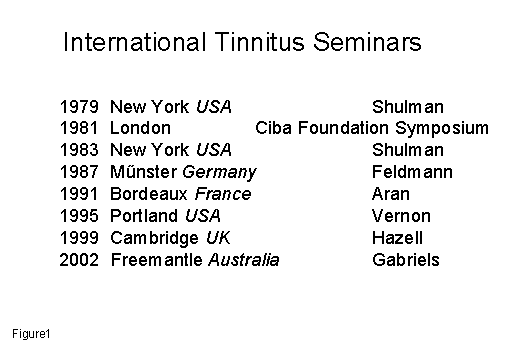
The next advance was to initiate a series of International meetings, the Tinnitus Seminars, the first two being hosted by Abe Shulman in New York, beginning in 1979. These are now held 3 yearly; the 7th International Seminar will be in
|
|
Australia in 2002 (See fig 1).
The Ciba Foundation hosted a Tinnitus symposium in 1981, which while not one of the seminar series, was important in the scientific format, discussion and its full, edited publication, which was the first of it’s kind to appear. In 1987 at the 3rd International Tinnitus Seminar, the International Tinnitus Advisory Board was founded to oversee the process of conference organisation, although, in the event, the board only met at the times of conferences. With the formation of the International Tinnitus and Hyperacusis Society, the process of continuity of the conferences series was vested in a new conference committee composed of ITHS members, and in 1999, at the 6th International Seminar, the ITAB was disbanded.
The process of tinnitus and hyperacusis research is marked, as in other scientific fields, by the publication of papers in journals, conference proceedings, and since 1980 a growing number of ‘text books’ and a tinnitus journal. Before the advent of Medline, the electronic on-line database, which has recorded all medical publications from 1966, there were but a handful of papers, and virtually none containing any promise for effective treatment.
This short paper looks at the development of tinnitus research through the published works, and the relative part played by the International Seminars.
Method
Using Medline, the papers published since 1966 were identified where the words ‘tinnitus’, or ‘hyperacusis’ appeared in the title. To include papers where these key words were also present in the abstract would have been misleading considering the frequency with which tinnitus occurs as a symptom in different medical conditions. The results were then analysed in time periods relating to the occurrence of International Seminars, which were clearly responsible for stimulating research endeavour. The papers were further allocated into difference research categories, to identify the various and changing orientations of research over the years. The process of peer review of published papers developed over the whole period in question, and therefore it has not been possible, or desirable, to indicate the provenance of this research. Any reader will find a very wide spectrum of scientific merit among these publications.
Results and discussion
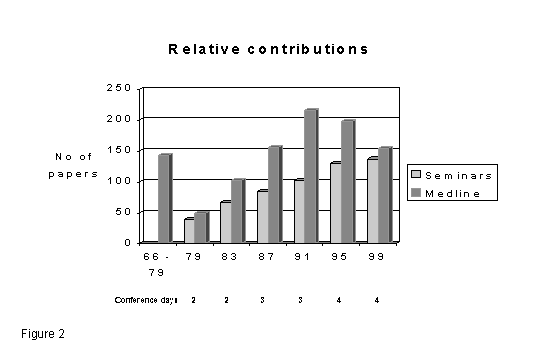
The total number of papers came to 1328. The distribution of papers prior to the conference series, and during the 4 year periods between seminars are shown in
|
|
figure 2.
As the conference proceedings of the first two seminars in 1979 and 1983 were published as a journal supplement cited by Medline, these papers appear twice in figure 2 and having therefore been deducted from the total. 143 papers are cited by Medline prior to the first International seminar. During the seminar series, up to September 1999, out of a total of 1471 papers, 560 (38%) were papers from the proceedings of seminars. In the early conferences the proceedings were assembled later (sometimes much later) resulting in a lower percentage of conference presentations being published. At the 6th International the proceedings were published during the conference with 137 out of 138 presented achieving publication. As the small group of researchers and clinicians interested in the problem slowly grew, so did the seminars, with the two lasting two days and the last two, four days, and containing parallel sessions.
Proceedings of the conferences
To analyse the interests of researchers in this field the content of papers from the Proceedings was divided into a number of different categories, Models and Aetiology, Tinnitus measurements, and Treatments. The results are presented graphically by conference year, as the percentage of papers from that conference that were published in the proceedings for that year.
Models and Aetiology
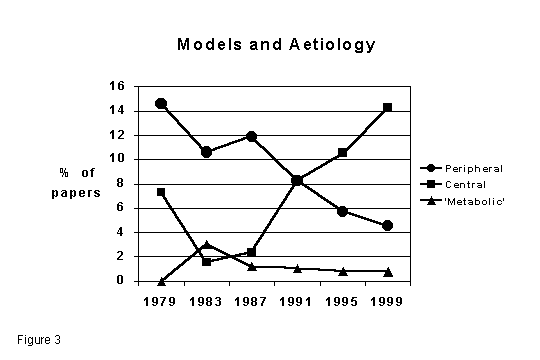
Those papers concerned with the mechanisms of tinnitus were assessed by their principal focus on the peripheral or central auditory system, or their concern with metabolic or other more non-specific mechanisms (figure 3).
|
|
The early preoccupation with tinnitus as a cochlear phenomen is clearly shown, followed by a realisation of the importance of central processing. The ‘Metabolic’ group included papers on alchohol, diet, allergies, metabolism and blood-pressure. The concepts that tinnitus could be the result of an extraneous physical event, although an argument beloved of patient support groups, held little interest for researchers, as it turned out.
Measurement
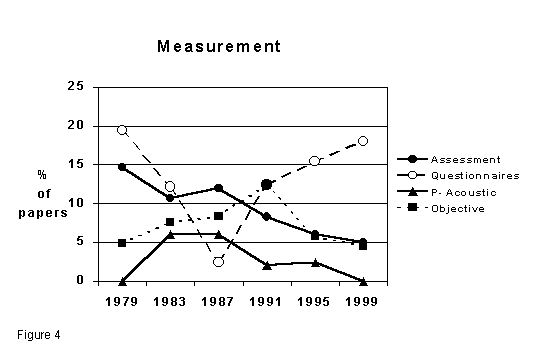
The problem that confronted researchers from the beginning was that it was very difficult to measure something which was essential a subjective perception, unique to the individual sufferer. This also confounded the audiologist in the assessment of the clinical problem, and made difficult the task of the researcher in measuring benefit from various therapies. In addition it became clear from early studies that psychoacoustical or ‘audiometric’ measurements did not reflect the distress experienced by the patient, or the factors that made tinnitus a clinical problem. Simple assessments of tinnitus, particularly with respect to time, e.g. ‘worse’, ‘same’, ‘better’, still have a validity, but more recently questionnaires which have undergone a process of validation, are becoming much more widespread in their use. The realisation that tinnitus distress involves other parts of the brain besides the auditory system necessitates a complex system of assessment or measurement.
Objective tests, in the early 1980s, were largely those of electric response audiometry e.g auditory brain stem responses (figure 4).
|
|
They proved to be too non-specific and insensitive to give much information about tinnitus. In the late 1980s and early 1990s measurements of cochlear function using transient evoked and distortion product otoacoustic emissions came into more general clinical use. There were great hopes, especially by those in the ‘tinnitus-is-in-the-ear’ camp, that these would measure tinnitus directly. The 1990s were characterised also by the development of functional MRI and PET scanning, making it possible to map changes in the brain related to function. The most exciting developments come from these studies where changes in brain activity coincided with an altered perception of tinnitus. While not a measurement of the clinical problem, they were adding to our understanding of the central processes in tinnitus and hyperacusis.
Tinnitus treatments
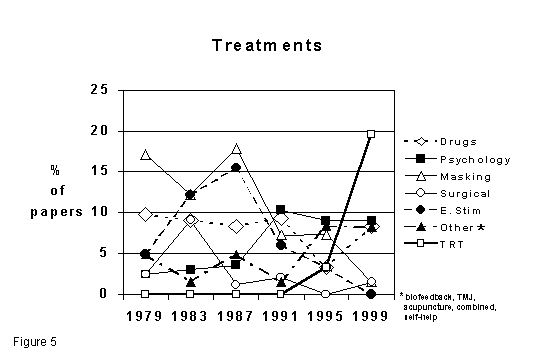
The main concern from the start was to find a ‘cure’ for a condition, which, since the beginning of time, was apparently untreatable, frequently destroyed the patient’s life, and went on relentlessly for ever. Figure 5 records the efforts of those participating in the International Seminar series.
Two issues emerge. First, the pioneering work of Jack Vernon and the Oregon team in developing tinnitus masking, which was the first effective treatment, at least for a minority of tinnitus sufferers. The decline of masking as an approach is shown clearly in figure 5 as increasing numbers find it is not effective in the long term, poorly tolerated in many, and only brings symptomatic relief in about
|
|
30% of patients. Western medicine is highly orientated in two perspectives: the ‘quick fix’, and drug therapy. Drug therapy should continue to concern us, particularly where it fails; and even when it succeeds there are often unacceptable side effects. Contributions to the series by psychologists are increasing, even though their numbers, compared to the audiologist at the clinical cutting edge, are small. The increasing awareness of central processing factors in tinnitus and hyperacusis makes their contributions valid and welcome. Electrical stimulation on the ear enjoyed a special interest in the 1980s following the success of cochlear implants in the treatment of total deafness. While significant improvement in tinnitus was noted among cochlear implant users, the use of implants in hearing tinnitus sufferers did not meet with good results, except in a few small trials. External application of electrical and radio wave stimuli, was also unsuccessful. Surgery was promoted by some centres, particularly those in the 1980s who believed they could remove the ‘source of tinnitus’ in the ear, and advocated acoustic nerve section. Again the increasing awareness of the non-dominant role played by the cochlear in tinnitus distress explains the failure of these approaches. The publication of Jastreboff’s neuro-physiological model of tinnitus in 1990 lead to the development of Tinnitus Retraining Therapy (TRT), an effective treatment that could be learned and applied by audiologists and otologists concerned with the day to day management of the clinical problem. The time scale is too short to predict the future in terms of the success for TRT, and the sharp growth curve of papers on TRT at the 1999 seminar shown in figure 5 will need to be followed in published papers and the 2002 seminar in Australia. Nevertheless the results from 15 different countries where there are centres practicing this technique on the majority of their patients is very encouraging.
Conclusion
Analysis of the trends in research can tell us much about what is important in the field of clinical management of difficult conditions like tinnitus and hyperacusis. While some of the papers in this series fall short of the strictest criteria for scientific merit, all must be applauded for the attempt to find an answer to a common and important clinical problem that so far has no cure. The peer-reviewed articles still remain very few compared to other areas of medicine with a similar high prevalence, though they are increasing by the year. Nevetheless the International Tinnitus Seminar series have provided an invaluable source of research material and continue to stimulate those in the field to work hard for the next conference.
Acknowledgments
This paper was presented in Chicago USA at a meeting of the American Academy of Audiology, March 1999, and published in ITHS Newsletter 1 December 2000.
References
Proceedings First International Tinnitus Seminar New York 1979 Ed Shulman A: J. Laryngol. Otol Suppl 4 1981
Ciba Foundation Symposium 85 London 1981 Ed Evered and Lawrenson: Pitman Press UK.
Proceedings Second International Tinnitus Seminar New York 1983 Ed Shulman A: J.Laryngol.Otol. Suppl. 9 1984.
Proceedings Third International Tinnitus Seminar, Muenster
Germany 1987, Ed Feldmann, H: Karlsruhe:Harsch Verlag, 1987
Tinnitus 91. Proceedings Fourth International Tinnitus Seminar, Bordeaux,
France, 1991, Ed Aran, J. and Dauman, R. Publ Amsterdam: Kugler Publications.
Proceedings Fifth International Tinnitus Seminar. 1995, Portland OR USA. Ed Reich and Vernon Publ. American Tinnitus Association Oregon USA
Proceedings Sixth International Tinnitus Seminar 1999 Cambridge UK. Ed Hazell J
Publ Immediate Proceedings Ltd. BungayMedline. National Library of Medicine USA; http://www.healthgate.com/medline/search-medline.shtml